UCanMakeItIfYouTry - Take Care of Yourself: When You Don't Sleep, Eat Crap, Don't Exercise, and Are Living Off Adrenaline for Too Long, Your Performance Suffers
Evelyn Glennie -- the Scottish percussionist who became one of the world's foremost solo musicians despite being profoundly deaf -- does not mince words: when you don't sleep, eat crap, don't exercise, and are living off adrenaline for too long, your performance suffers. Not might suffer. Suffers. It is a statement of fact from someone who has spent a lifetime understanding exactly what the human body and mind require to perform at their best.
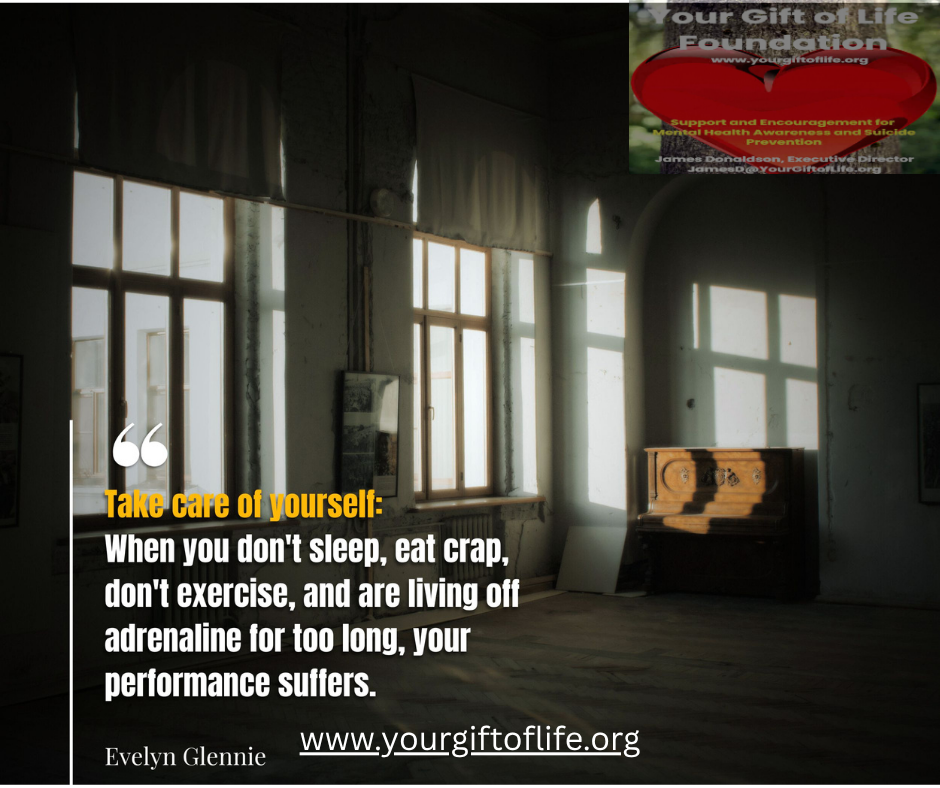
Take Care of Yourself: When You Don't Sleep, Eat Crap, Don't Exercise, and Are Living Off Adrenaline for Too Long, Your Performance Suffers
"Take care of yourself: When you don't sleep, eat crap, don't exercise, and are living off adrenaline for too long, your performance suffers." -- Evelyn Glennie
Evelyn Glennie was told at the age of twelve that she could not pursue a career in music. She was profoundly deaf, and the conventional wisdom was that deafness and musical performance were simply incompatible. She disagreed. She went on to become one of the most celebrated solo percussionists in the world, performing with the greatest orchestras and musicians on the planet, composing, teaching, and demonstrating through every year of her career that the conventional wisdom was wrong.
She learned to hear music through her entire body -- feeling vibrations through the floor, through her hands, through her bones. This required an extraordinary level of physical attunement, a relationship with her body that most people never develop. And from that relationship came a clarity about what the body needs to perform -- and what happens when those needs are ignored.
Her words here are not gentle. She does not say "it might be helpful to get more sleep." She says: when you don't sleep, eat crap, don't exercise, and are living off adrenaline for too long, your performance suffers. Direct. Unambiguous. True.
The Four Pillars She Names
Glennie identifies four specific things -- not as a comprehensive wellness checklist, but as the core foundations that, when neglected, directly degrade performance. Each one is worth examining on its own terms.
Sleep. We have already established in recent posts that sleep is not a luxury -- it is the period during which the brain consolidates learning, clears biological waste, and restores the cognitive resources that waking life depletes. But Glennie's framing adds something important: she connects sleep directly to performance. Not to health in the abstract. To performance -- to the quality of what you actually produce, the sharpness of your thinking, the precision of your execution, the creativity of your problem-solving. When you do not sleep, your performance suffers. Not your mood, not your energy levels in some vague sense -- your actual output, the thing you are trying to do well, degrades. This is not a soft claim. It is one of the most robustly supported findings in all of performance science.
Nutrition. "Eat crap" is Glennie's characteristically direct way of naming something that most of us know but consistently underestimate: what you put into your body directly affects what your body and brain can do. The brain is an extraordinarily energy-intensive organ -- it consumes roughly twenty percent of the body's total energy despite being only about two percent of its mass. It is exquisitely sensitive to the quality of the fuel it receives. A diet high in processed foods, refined sugars, and inflammatory ingredients does not just affect your waistline or your long-term health risk. It affects your cognitive function right now -- your focus, your mood, your energy levels, your capacity for sustained attention and clear thinking. The person who skips breakfast, eats fast food at their desk, and runs on caffeine and sugar is not performing at their best. They are performing at a fraction of their best, and they have often been doing it for so long that they have forgotten what their best actually feels like.
Exercise. The research on exercise and cognitive performance is unambiguous and remarkable. Regular physical activity increases blood flow to the brain, promotes the growth of new neural connections, reduces inflammation, improves mood through the release of endorphins and other neurochemicals, reduces anxiety and depression, improves sleep quality, and enhances executive function -- the cluster of cognitive abilities that includes planning, focus, decision-making, and impulse control. Exercise is not just good for your body. It is one of the most powerful things you can do for your brain. The person who exercises regularly thinks more clearly, manages stress more effectively, and sustains high performance over longer periods than the person who does not. Glennie names it as a non-negotiable foundation, and the science backs her completely.
Adrenaline. This is the most nuanced of the four, and perhaps the most important for the modern moment. Adrenaline -- the stress hormone that activates the fight-or-flight response -- is not inherently bad. In short bursts, it sharpens focus, increases energy, and enables the kind of peak performance that athletes and performers know well. The problem is chronic adrenaline -- the state of sustained stress activation that many people in modern life have come to treat as their normal operating mode.
When you are living off adrenaline for too long, several things happen. The adrenal glands that produce stress hormones become fatigued. The nervous system, designed for short bursts of high activation followed by recovery, never gets the recovery it needs. The body stays in a state of physiological high alert that was designed for emergencies, not for everyday life. Cortisol -- the longer-acting stress hormone -- remains chronically elevated, which impairs immune function, disrupts sleep, promotes inflammation, and over time damages the very cognitive systems it was meant to protect. The person living off adrenaline feels productive -- the buzz of stress activation can feel like energy and focus -- but they are running on borrowed time, depleting reserves that are not being replenished, and heading toward a crash that is as inevitable as it is avoidable.
Why High Performers Are Especially Vulnerable
There is a particular irony in Glennie's quote that is worth naming: the people most likely to neglect these four foundations are often the people who care most about their performance. The driven, the ambitious, the deeply committed -- these are the people most likely to sacrifice sleep for one more hour of work, to eat whatever is convenient rather than what is nourishing, to skip exercise because there is not enough time, and to run on adrenaline because the urgency of what they are trying to accomplish feels too great to slow down for.
And so the very people who most want to perform at their best are often the ones most systematically undermining their capacity to do so. They are treating self-care as a competitor to performance rather than as its foundation. They are borrowing against their own reserves, and the debt compounds with interest.
Glennie knows this from the inside. As a world-class performer who has sustained excellence over decades, she understands that the foundation of extraordinary performance is not grinding harder. It is taking care of the instrument. For a percussionist, the instrument is the drums and the mallets. But the musician is also an instrument -- the body and mind through which the music flows -- and that instrument requires maintenance.
The same is true for every one of us. Whatever your work is -- whether you are a parent, a teacher, an entrepreneur, an athlete, an artist, a caregiver, or anything else -- you are the instrument through which that work flows. And the quality of the work is inseparable from the condition of the instrument.
The Adrenaline Trap in Everyday Life
It is worth spending a moment on the adrenaline piece specifically, because it is the one that is hardest to recognize from the inside.
Chronic stress activation does not always feel like stress. After a while, it feels like normal. The baseline level of tension, urgency, and low-grade anxiety that comes from living off adrenaline becomes so familiar that we stop noticing it. We think we are fine -- we are functioning, we are getting things done, we are keeping up -- and we do not realize how far we have drifted from what fine actually feels like until something forces a reset.
The reset might be an illness that forces rest. A vacation that, after the first few days of decompression, reveals how depleted we actually were. A moment of genuine stillness in which we notice, with some surprise, how long it has been since we felt truly at ease.
The adrenaline trap is particularly insidious because it is self-reinforcing. Chronic stress impairs sleep, and poor sleep increases stress reactivity, which increases adrenaline, which further impairs sleep. It disrupts nutrition -- stress eating, appetite suppression, poor food choices made in a depleted state -- which further degrades cognitive function and stress resilience. It reduces the motivation to exercise, which removes one of the most effective stress-reduction tools available. The four foundations Glennie names are not independent -- they are deeply interconnected, and when one falls, the others are pulled down with it.
Rebuilding the Foundation
If you recognize yourself in Glennie's description -- if you are not sleeping enough, eating poorly, skipping exercise, and running on adrenaline -- the path forward is not complicated, though it is not easy.
Start with sleep. It is the foundation of the foundation. Without adequate sleep, every other effort at self-care is working against a headwind. Protect seven to nine hours. Make it non-negotiable. The work will still be there in the morning, and you will do it better rested.
Make one nutritional improvement at a time. Not a complete dietary overhaul -- that is unsustainable. One change. More water. A real breakfast. One fewer processed snack replaced with something that actually nourishes. Small, consistent improvements compound over time into a genuinely different relationship with food.
Find the exercise that you will actually do. Not the exercise that is theoretically optimal. The one you will actually do, consistently, because you find it tolerable or even enjoyable. A thirty-minute walk every day is worth more than an intense gym program you abandon after two weeks.
And address the adrenaline. This means building genuine recovery into your life -- not just sleep, but moments of real downtime during the day. It means addressing the sources of chronic stress where you can. It means learning to recognize the difference between productive urgency and the kind of chronic activation that is depleting rather than energizing.
None of this is complicated. All of it is hard, in the way that anything worth doing is hard. But Glennie's point is simple and true: your performance depends on it. Not your performance in some abstract future when you have time to take care of yourself. Your performance right now, today, in the work and the relationships and the life that matter most to you.
Take care of yourself. Not as a reward for performing well. As the condition that makes performing well possible.
You can make it if you try. And taking care of the instrument -- your body, your mind, your whole self -- is one of the most important ways to try.
Of the four foundations Glennie names -- sleep, nutrition, exercise, and adrenaline -- which one is most out of balance in your life right now? What is one concrete step you could take today to begin restoring it?
Explore Topics
Written by
James Donaldson
Content creator and writer sharing insights and stories.