UCanMakeItIfYouTry - You Don't Have to Control Your Thoughts. You Just Have to Stop Letting Them Control You.
Dan Millman offers one of the most freeing insights in all of mental health: the goal was never to silence your thoughts. It was to stop being ruled by them. That shift -- from control to observation -- changes everything.
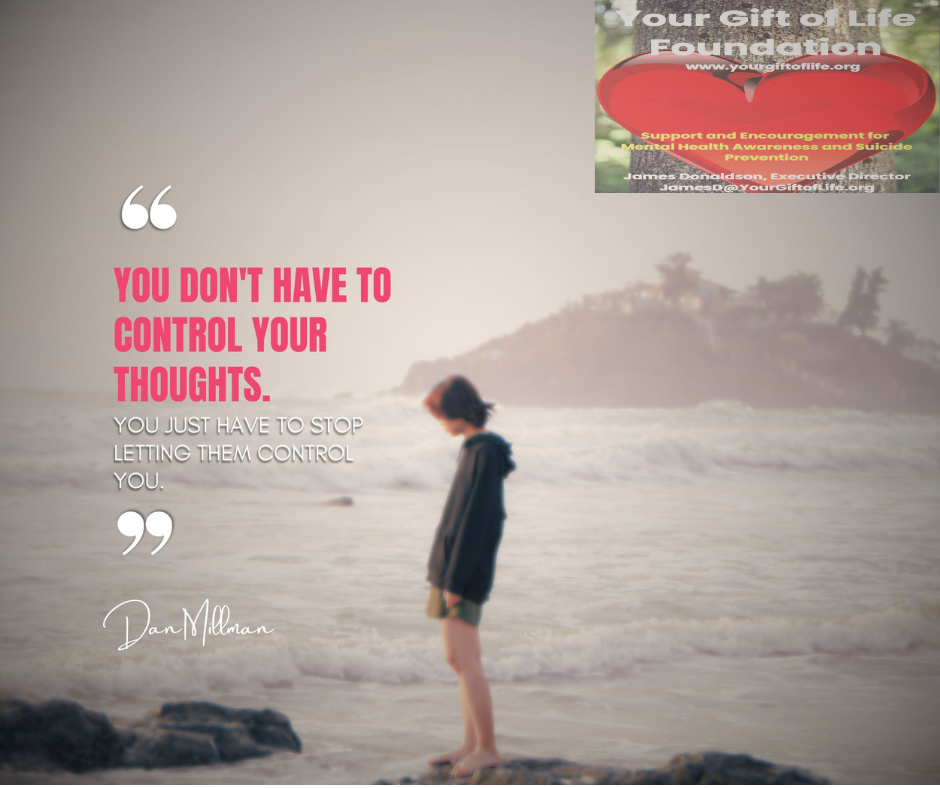
You Don't Have to Control Your Thoughts. You Just Have to Stop Letting Them Control You.
-- Dan Millman
Dan Millman, the author of Way of the Peaceful Warrior and one of the most thoughtful voices on the inner life, gave us something genuinely liberating in this quote.
Not a harder task. An easier one.
Because most of us have been trying to do the wrong thing. We have been trying to control our thoughts -- to silence the anxious ones, banish the dark ones, force the positive ones to stay. And we have been failing, and feeling like failures because of it.
Millman is telling us: that was never the assignment.
You do not have to control your thoughts. You just have to stop letting them control you.
The Exhausting Project of Thought Control
If you have ever tried to stop thinking about something, you already know how this goes.
The moment you tell yourself do not think about that, the thought doubles in size. The harder you push it away, the more insistently it returns. Psychologists call this the ironic process -- the mental effort to suppress a thought requires you to monitor for that thought, which keeps it active and present in exactly the way you were trying to avoid.
This is why people who struggle with anxiety often find that fighting their anxious thoughts makes the anxiety worse, not better. The battle itself becomes exhausting. The effort to control the mind becomes its own source of stress. And when the thoughts return -- as they always do -- it feels like evidence of failure, which generates more anxious thoughts, which require more effort to suppress, and the cycle tightens.
Millman is offering a way out of the cycle entirely. Not by winning the battle, but by stepping off the battlefield.
The Observer and the Thought
Here is the insight at the heart of this quote, and at the heart of mindfulness, cognitive therapy, and virtually every wisdom tradition that has grappled seriously with the human mind:
You are not your thoughts. You are the one who notices them.
Thoughts arise in the mind the way clouds move across the sky. They appear, they drift, they change shape, they pass. The sky does not become the cloud. The sky simply holds the space in which clouds move.
You are the sky. Your thoughts are the clouds.
When a difficult thought arises -- the anxious thought, the self-critical thought, the catastrophic thought, the thought that says you are not enough or this will never work or everything is falling apart -- you do not have to fight it. You do not have to believe it. You do not have to make it go away.
You just have to notice it without being swept away by it.
There is that thought again. I see you. You are not in charge here.
That noticing -- that small, quiet act of observation -- is the difference between a thought controlling you and a thought simply passing through.
What It Means to Stop Letting Them Control You
A thought controls you when you treat it as a command rather than an event.
The anxious thought says something terrible is about to happen, and you reorganize your entire day around avoiding the imagined catastrophe. The self-critical thought says you are not good enough, and you withdraw from the opportunity you were about to pursue. The hopeless thought says nothing will ever change, and you stop trying.
In each case, the thought issued an instruction and you followed it -- not because you chose to, but because you did not realize you had a choice.
Stopping the thought from controlling you does not mean the thought disappears. It means you see it for what it is: a mental event, not a fact. A weather pattern in the mind, not a verdict on your life.
You can have the anxious thought and still take the action. You can have the self-critical thought and still show up. You can have the hopeless thought and still keep going.
The thought does not have to be gone for you to move forward. It just has to stop being the one driving.
The Practice
This is not a one-time insight. It is a practice -- something you return to again and again, especially in the moments when the thoughts are loudest and most insistent.
When you notice a thought pulling you toward anxiety, self-doubt, or despair, try this:
Pause. Name it. I am having the thought that... This simple act of labeling creates a small but real distance between you and the thought. It moves the thought from something you are inside of to something you are observing.
Then ask: Is this thought helping me right now? Is it accurate? Is it the whole story?
You do not have to answer perfectly. You do not have to replace the thought with a cheerful one. You just have to interrupt the automatic obedience -- the reflex that says the thought appeared, therefore it must be true, therefore I must act on it.
You are not obligated to follow every thought to its conclusion. You are allowed to let it pass.
You Can Make It
You will never have a mind that produces only calm, helpful, positive thoughts. No one does. The mind generates all kinds of weather -- some of it beautiful, some of it stormy, some of it just grey and overcast and unremarkable.
You do not have to control the weather. You just have to remember that you are not the storm.
You are the one watching it. And the one watching it is steadier, deeper, and more capable than any thought that passes through.
Stop trying to silence the thoughts. Start practicing the art of not being ruled by them.
You can make it. You already have everything you need.
Your Gift of Life Foundation is dedicated to mental health awareness and helping people find freedom from the thoughts that hold them back. Visit us at www.yourgiftoflife.org.
Explore Topics
Written by
James Donaldson
Content creator and writer sharing insights and stories.