UCanMakeItIfYouTry - The Greatest Weapon Against Stress Is Our Ability to Choose One Thought Over Another
William James, the father of American psychology, identified something remarkable: we cannot always control what happens to us, but we can always choose what we think about it. That single insight may be the most powerful stress-management tool ever discovered.
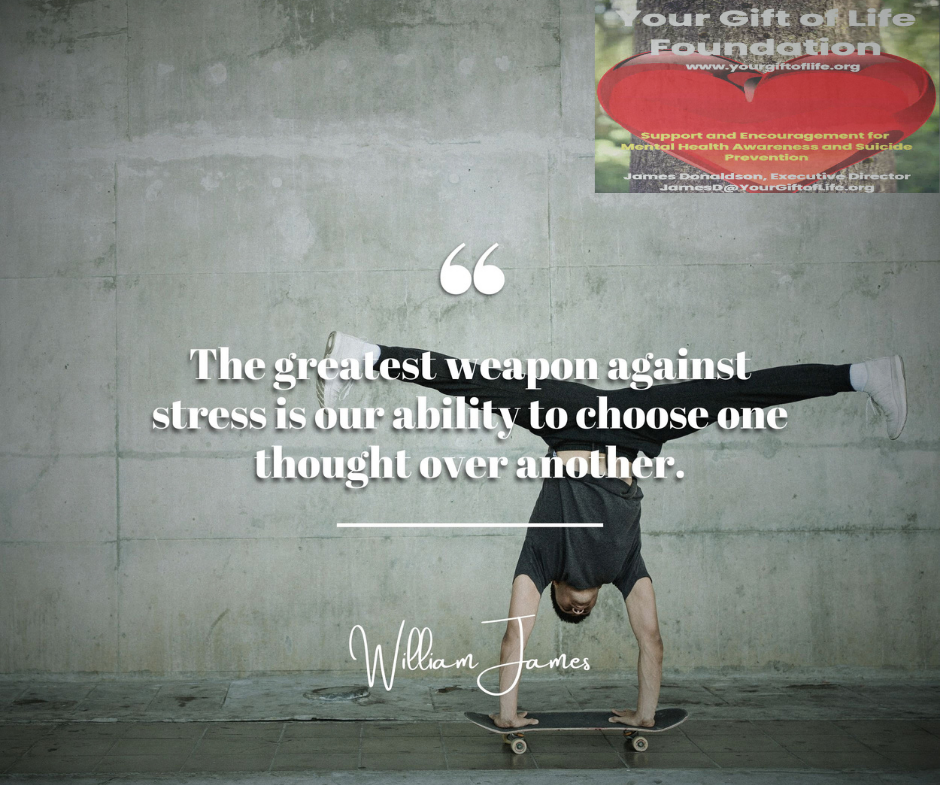
The Greatest Weapon Against Stress Is Our Ability to Choose One Thought Over Another
-- William James
William James was not a motivational speaker. He was a philosopher, a psychologist, and one of the most rigorous scientific minds of the nineteenth century. He spent decades studying the human mind -- how it works, how it breaks down, and how it heals.
And this is what he concluded: the greatest weapon we have against stress is not medication, not escape, not the removal of difficulty from our lives. It is the ability to choose one thought over another.
That is a remarkable claim. And it is worth sitting with, because most of us do not live as though we believe it.
The Stress We Actually Experience
Here is something that stress researchers have understood for decades, and that most of us have experienced but rarely examined: two people can face the exact same situation and have completely different stress responses.
Same traffic jam. Same difficult conversation. Same financial pressure. Same diagnosis. One person is overwhelmed; another is calm. One person spirals; another steadies.
What is the difference? It is not the situation. It is the thought about the situation.
The stress we experience is almost never a direct response to external events. It is a response to our interpretation of those events -- the story we tell ourselves about what is happening, what it means, and what it says about our future. Change the story, and you change the stress response. Not always immediately, not always completely, but meaningfully and measurably.
William James understood this before the neuroscience existed to confirm it. The mind, he argued, is not a passive receiver of experience. It is an active participant in creating it.
You Are Not Your Thoughts
One of the most liberating insights in all of psychology -- ancient in wisdom traditions, confirmed in modern cognitive science -- is this: you are not your thoughts. You are the one who notices them.
Thoughts arise. They appear in the mind unbidden, often unwelcome, frequently unhelpful. The anxious thought, the catastrophic thought, the thought that says this is too much or I cannot handle this or everything is falling apart -- these thoughts are not facts. They are not commands. They are not the truth about your situation.
They are just thoughts. And you have the ability to choose which ones you feed.
This is what James means by choosing one thought over another. Not suppressing the difficult thought -- that rarely works and often backfires. Not pretending the stressor does not exist. But deliberately, consciously turning your attention toward a thought that is more useful, more accurate, more aligned with what you actually want to create in your life.
This is hard, and I have handled hard things before.
I do not know how this ends, and I have survived uncertainty before.
This moment is difficult, and this moment will pass.
These are not denials of reality. They are more complete versions of it -- ones that include your own resilience alongside the difficulty.
The Practice of Choosing
Choosing one thought over another is a skill. Like any skill, it requires practice. And like any skill, it gets easier the more you do it.
The first step is simply noticing. Before you can choose a different thought, you have to become aware of the thought you are currently having. Most of us move through our days on autopilot, our stress responses triggered by thoughts we never consciously examined. The anxious loop runs in the background, shaping our mood and our choices, without ever being brought into the light.
Pause. Notice. Ask: What am I actually thinking right now? Is this thought helping me or hurting me? Is it accurate, or is it a worst-case story I am telling myself?
Then choose. Not perfectly, not permanently -- just for this moment. Reach for a thought that is truer, steadier, more useful. Not toxic positivity, not forced cheerfulness, but honest reframing: What else is also true here?
Done consistently, this practice rewires the brain. The neural pathways that lead to catastrophizing weaken from disuse. The ones that lead to steadiness and resilience strengthen. This is not metaphor -- it is neuroscience. The brain changes in response to the thoughts we habitually choose.
The Weapon Is Already in Your Hands
William James called this a weapon, and the word is deliberate. Stress is not a minor inconvenience. For many people, it is a genuine threat to health, to relationships, to the quality and length of life itself. The ability to choose one thought over another is not a soft skill or a nice-to-have. It is a survival tool.
And here is the most important thing: you already have it. You were born with it. It has been available to you every single day of your life, in every difficult moment you have ever faced.
You may not have known it was there. You may not have been taught how to use it. But it is yours. It has always been yours.
You Can Make It
Whatever is pressing on you today -- whatever stress is sitting on your chest or running through your mind -- you have a weapon against it. Not a perfect one, not an instant one, but a real and powerful one.
You can choose what you think about this.
Not what happened. Not what is true. But what you focus on, what story you tell, what thought you feed with your attention.
Choose the one that helps you stand up. Choose the one that reminds you of your strength. Choose the one that tells the whole truth -- including the part where you are still here, still trying, still capable of making it through.
Because you are. And you can.
Your Gift of Life Foundation is dedicated to mental health awareness and helping people discover the inner resources they already carry. Visit us at www.yourgiftoflife.org.
Explore Topics
Written by
James Donaldson
Content creator and writer sharing insights and stories.