UCanMakeItIfYouTry - Life Is a Series of Natural and Spontaneous Changes. Don't Resist Them; That Only Creates Sorrow. Let Reality Be Reality. Let Things Flow Naturally Forward in Whatever Way They Like.
Lao Tzu -- the ancient Chinese philosopher whose Tao Te Ching has guided human beings through uncertainty for more than two thousand years -- gave us one of the most complete and practical teachings on the nature of change ever written. Not just an observation about life, but a full instruction: here is what life is, here is what resistance does, and here is what to do instead.
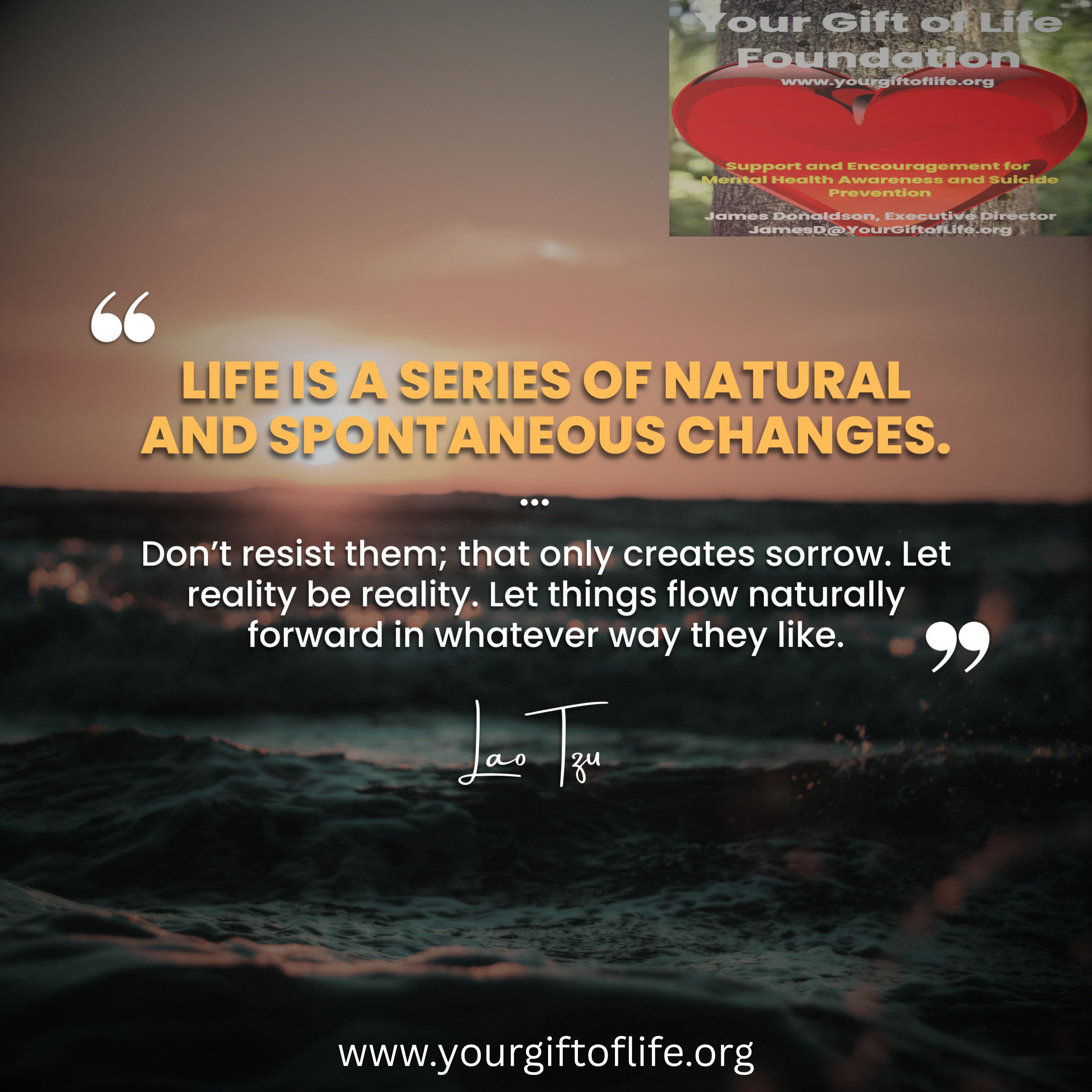
Life Is a Series of Natural and Spontaneous Changes. Don't Resist Them; That Only Creates Sorrow. Let Reality Be Reality. Let Things Flow Naturally Forward in Whatever Way They Like.
-- Lao Tzu
Look at the image that accompanies these words.
An ocean at dusk, waves rolling in from a darkening horizon, the sky lit with the last warm gold of a setting sun. The water is in constant motion -- surging, receding, reshaping the surface moment by moment. Nothing in this image is still. Nothing is fixed. And yet there is no chaos here, no violence in the movement. The waves do not resist the shore. The tide does not argue with the moon. Everything flows, naturally and spontaneously, in whatever way it likes.
This is the world Lao Tzu is describing. And he is asking us to live in it the same way the ocean does -- not by fighting the movement, but by moving with it.
The Nature of Change
Lao Tzu begins with a simple statement of fact: life is a series of natural and spontaneous changes.
Not some changes. Not occasional disruptions to an otherwise stable existence. A series -- continuous, ongoing, one following another without end. This is not a pessimistic view of life. It is an honest one. The seasons change. Relationships change. Bodies change. Careers change. The people we love change, and so do we. The circumstances we counted on shift beneath our feet, and new ones take their place, and those shift too.
The word spontaneous is important here. These changes do not always announce themselves. They do not wait for our permission or our readiness. They arise from the nature of things -- from the Tao, in Lao Tzu's framework -- and they move according to their own logic, not ours. A diagnosis arrives on an ordinary Tuesday. A relationship ends on what seemed like a normal evening. An opportunity appears from a direction we were not watching. Life does not consult our schedule.
This is not a problem to be solved. It is the nature of existence itself. And the first step toward living well within it is simply to see it clearly -- to stop being surprised that things change, and to recognize change as the fundamental texture of life rather than an interruption of it.
What Resistance Does
The second part of Lao Tzu's teaching is the one most people need most: don't resist them; that only creates sorrow.
This is not a gentle suggestion. It is a precise causal statement. Resistance does not prevent change -- change happens regardless. What resistance does is create sorrow. The suffering is not in the change itself. It is in the fighting of it.
Think about what resistance actually looks like in practice. It is the hours spent replaying a conversation that cannot be undone, wishing it had gone differently. It is the energy consumed by anger at a situation that is already true -- the job that was lost, the health that has changed, the relationship that has ended. It is the exhausting mental labor of insisting, over and over, that things should be other than they are.
None of this changes anything about the situation. The situation is what it is. What resistance changes is the quality of our experience -- it adds a layer of suffering on top of the difficulty that was already there. We are not just dealing with the hard thing; we are also dealing with our refusal to accept that the hard thing is real. And that refusal, Lao Tzu tells us, is the source of sorrow.
This does not mean we should be passive in the face of injustice, or that we should not work to change what can be changed. Lao Tzu is not counseling resignation. He is counseling clarity -- the ability to see what is actually true, accept it as the starting point, and then respond from that clear-eyed place rather than from the fog of resistance.
Let Reality Be Reality
Four words that contain an entire philosophy: let reality be reality.
This is harder than it sounds. Most of us, most of the time, are not actually engaging with reality. We are engaging with our story about reality -- our interpretation of it, our judgment of it, our insistence on how it should be different. We are in a constant, low-grade argument with what is, and that argument consumes enormous amounts of energy that could go toward actually living.
Letting reality be reality means dropping the argument. Not agreeing that everything is good, or that nothing should ever change, or that difficult things are not difficult. It means acknowledging what is actually true -- clearly, honestly, without the overlay of how it should be -- and working from there.
When we do this, something remarkable happens. The energy that was going into the argument becomes available. We can see our options more clearly. We can respond more skillfully. We can find, even in difficult circumstances, the path forward that was invisible while we were busy insisting the circumstances were wrong.
Let Things Flow Naturally Forward
The final instruction is the most beautiful and the most demanding: let things flow naturally forward in whatever way they like.
This is the Taoist concept of wu wei -- effortless action, moving with the current rather than against it. Not passivity, but alignment. The willow bends in the storm and survives; the oak resists and breaks. The water finds its way around the stone, not by forcing, but by flowing.
In practical terms, this means trusting the process of life even when you cannot see where it is going. It means releasing the need to control every outcome and allowing some things to unfold according to their own nature. It means recognizing that your role is not to force life into the shape you have decided it should take, but to move skillfully within the shape it is actually taking.
This is not easy for people who have been taught that control is safety, that planning is virtue, that the right response to uncertainty is to grip harder. But Lao Tzu -- and two thousand years of people who have found wisdom in his words -- is telling us something different: the grip is the problem. The flow is the answer.
Change and Mental Health
The connection between resistance to change and mental suffering is one of the most consistent findings in modern psychology. Anxiety, at its core, is often resistance to uncertainty -- the mind's attempt to control outcomes it cannot control, to prevent changes it cannot prevent. Depression frequently involves resistance to loss -- the refusal to accept that something is gone, the endless replaying of what was.
Acceptance-based therapies, mindfulness practices, and contemplative traditions across cultures all converge on the same insight that Lao Tzu expressed twenty-five centuries ago: the path through suffering runs not around difficulty but through acceptance of it. Not resignation, but clear-eyed acknowledgment. Not giving up, but letting go of the fight with what is already true.
When we stop resisting change and start moving with it, the nervous system settles. The mind clears. The energy that was locked in the argument becomes available for living. And the changes that seemed so threatening, seen from the other side of acceptance, often reveal themselves as the very things that moved us forward.
You Can Make It
Whatever change you are facing today -- whatever shift in your circumstances, your relationships, your health, your plans -- Lao Tzu's ancient words are as current as this morning.
Life is a series of natural and spontaneous changes. This one is part of that series. Don't resist it; that only creates sorrow. Let reality be reality -- see it clearly, accept it as your starting point. And let things flow naturally forward in whatever way they like.
The ocean in the image does not grieve the shape of the last wave. It is already becoming the next one.
You can make it -- and the flow will carry you further than the fight ever could.
Your Gift of Life Foundation is dedicated to mental health awareness, resilience, and the belief that accepting life's natural changes -- rather than fighting them -- is one of the most powerful things a person can do for their own wellbeing. Visit us at www.yourgiftoflife.org.
Explore Topics
Written by
James Donaldson
Content creator and writer sharing insights and stories.