UCanMakeItIfYouTry - The Art of Living Lies Less in Eliminating Our Troubles Than in Growing With Them
Bernard Baruch -- financier, statesman, and one of the most quietly wise voices of the twentieth century -- offers us a reframe that changes everything: the goal of a well-lived life is not to be trouble-free. It is to grow. Not past your troubles, not despite them, but with them. The troubles are part of the art.
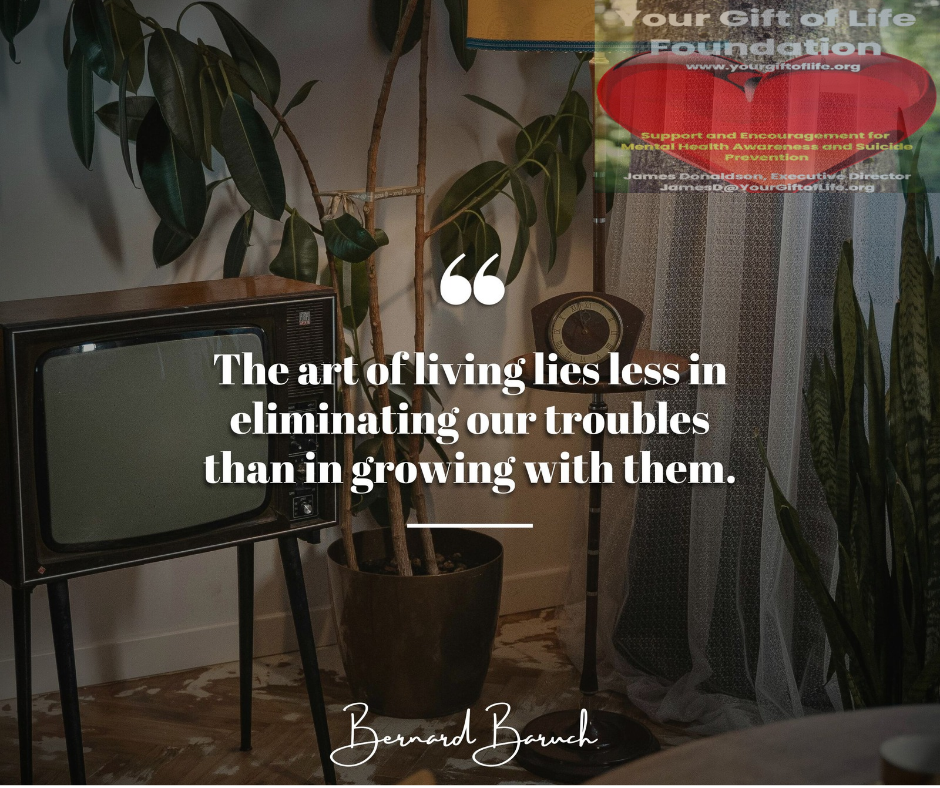
The Art of Living Lies Less in Eliminating Our Troubles Than in Growing With Them
"The art of living lies less in eliminating our troubles than in growing with them." -- Bernard Baruch
Bernard Baruch lived a long and remarkable life -- nearly a century, from 1870 to 1965. He made a fortune on Wall Street before he was thirty, advised presidents from Woodrow Wilson to Dwight Eisenhower, and spent decades as one of the most influential private citizens in American public life. He had every reason to believe that success meant solving problems, eliminating obstacles, and arriving at a place where things finally worked smoothly.
And yet this is what he concluded: the art of living lies less in eliminating our troubles than in growing with them.
Not solving them. Not escaping them. Growing with them.
It is one of the most quietly radical ideas a person can hold. And it changes everything about how you approach your life.
The Elimination Fantasy
Most of us are operating, at least in part, under what we might call the elimination fantasy -- the belief that the good life is the trouble-free life, and that the goal of all our effort is to reach a point where the difficulties have been resolved, the problems have been solved, and we can finally live in peace.
This fantasy takes many forms. We tell ourselves: when I get through this difficult season at work, things will settle down. When the kids are older, life will be easier. When the finances stabilize, I will be able to relax. When this health issue is resolved, I will feel like myself again. When I have figured out this relationship, we will finally be okay.
The fantasy is not entirely wrong. Circumstances do improve. Problems do get solved. Difficult seasons do end. And working toward better circumstances is not only reasonable -- it is necessary and good.
The problem is the underlying assumption: that the destination of all this effort is a life without troubles. That somewhere ahead, if we work hard enough and make the right choices and get a little lucky, we will arrive at a place where the difficulties have been cleared away and the real living can begin.
Baruch, who had seen more of life than most, is telling us gently but clearly: that place does not exist. The troubles do not get eliminated. They change shape. They evolve. New ones arrive as old ones resolve. The person who has finally solved the financial problem discovers a health problem. The person who has finally found peace in one relationship finds turbulence in another. The person who has finally achieved the career goal discovers that the goal brought its own complications.
This is not pessimism. It is accuracy. And accepting it -- really accepting it, not just intellectually but in the way you actually live -- is one of the most liberating things you can do.
What Growing With Troubles Actually Means
If the goal is not elimination, what is it? Baruch says it is growth. But what does it mean to grow with your troubles, rather than simply enduring them or trying to get past them?
Growing with your troubles means allowing them to change you -- not break you, but change you. It means being willing to be shaped by difficulty rather than simply surviving it. It means asking not just "how do I get through this?" but "what is this asking of me? What is it developing in me? Who am I becoming in the process of navigating this?"
This is a fundamentally different orientation toward difficulty. Instead of treating troubles as obstacles between you and your real life, you treat them as part of your real life -- as the very material out of which a meaningful, developed, genuinely lived life is made.
Think about the people you most admire. The ones whose character you respect, whose wisdom you trust, whose presence feels substantial and real. Almost without exception, those qualities were forged in difficulty. The patience was learned through situations that required patience. The compassion was developed through experiences of suffering. The resilience was built through repeated encounters with adversity. The wisdom was earned through mistakes and losses and hard-won lessons.
None of that comes from a trouble-free life. It comes from a life in which troubles were met, engaged, and grown through.
The Difference Between Enduring and Growing
It is worth being precise here, because not all responses to trouble produce growth. Some people endure their difficulties without growing through them -- they survive the hard season, but they come out the other side essentially unchanged, or even more contracted, more defended, more closed off than before.
The difference between enduring and growing lies largely in engagement. Enduring is passive -- you wait for the difficulty to pass, you keep your head down, you get through it. Growing is active -- you bring your attention and your curiosity and your willingness to the difficulty. You ask what it is teaching you. You stay open to being changed by it.
Enduring says: I just need to get through this. Growing says: I need to be present to this, because something important is happening here.
Enduring treats the trouble as an interruption to your real life. Growing treats it as part of your real life -- perhaps one of the most important parts.
This does not mean manufacturing meaning where there is none, or pretending that painful things are secretly good. Some troubles are genuinely terrible. Some losses are real and irreplaceable. Some difficulties leave marks that never fully heal. Acknowledging that is not weakness -- it is honesty.
But even in the most genuinely difficult circumstances, there is usually a choice about how to be present to what is happening. Whether to close down or stay open. Whether to become bitter or become deeper. Whether to let the trouble diminish you or allow it, over time, to expand you.
Troubles as Teachers
One of the most useful ways to think about this is to treat your troubles as teachers -- not in a sentimental way, but in a practical one. What is this particular difficulty actually teaching you?
A financial struggle might be teaching you about your relationship with security, with risk, with the difference between what you need and what you want. A difficult relationship might be teaching you about your own patterns, your communication habits, the ways you show up or fail to show up for the people you care about. A health challenge might be teaching you about your body, about your limits, about what actually matters when the nonessential is stripped away. A professional setback might be teaching you about your assumptions, your resilience, your capacity to adapt and begin again.
None of these lessons are comfortable. Most of them are things we would rather not learn, or would prefer to learn some other way. But they are real, and they are valuable, and they are available -- if we are willing to engage with the trouble rather than simply trying to escape it.
This is what Baruch means by the art of living. Art requires engagement. It requires attention, skill, and a willingness to work with the material you have -- not the material you wish you had. The artist does not wait for perfect conditions. The artist works with what is present, and through that engagement, creates something that would not have existed otherwise.
Your life is the art. Your troubles are part of the material. The question is not how to eliminate the difficult material, but how to work with it -- how to grow with it -- in a way that produces something genuine and meaningful.
Practical Wisdom for Growing With Troubles
How do you actually do this? How do you shift from the elimination orientation to the growth orientation in the middle of a real difficulty?
Start by naming what the trouble is actually asking of you. Not what you wish it were asking, not what you think you should be learning -- but what it is genuinely demanding. Patience? Honesty? Courage? Humility? Flexibility? The answer is often uncomfortable, which is usually a sign that it is accurate.
Resist the urge to fast-forward. One of the most common ways we fail to grow with our troubles is by spending all our energy trying to get past them as quickly as possible. We want the lesson without the experience, the growth without the process. But growth does not work that way. It requires time and presence. Slow down enough to actually be in the difficulty, rather than just trying to escape it.
Look for what is being strengthened. Even in the hardest circumstances, something is usually being built -- a capacity, a quality, a depth of understanding that was not there before. Identifying it does not make the difficulty easier, but it does make it more meaningful. And meaning is one of the most powerful resources a human being has.
Talk to people who have grown through similar troubles. One of the gifts of human community is that we do not have to navigate difficulty alone or without precedent. Someone has been where you are. Someone has grown through what you are growing through. Their experience is not a roadmap -- your path will be your own -- but it is evidence that growth is possible, and that is sometimes exactly what you need.
Be patient with yourself. Growth is rarely linear. There are setbacks, regressions, days when you feel like you are moving backward rather than forward. This is normal. It is part of the process. The measure is not whether every day is better than the last, but whether, over time, you are becoming more of who you are capable of being.
The Art Is in the Living
Baruch called it the art of living -- not the science, not the strategy, not the optimization. The art. And that word choice matters.
Art is not about achieving a perfect outcome. It is about the quality of engagement with the process. It is about showing up fully to the material you have, bringing your best attention and your deepest care, and creating something -- a life, a character, a way of being in the world -- that could not have existed without that engagement.
Your troubles are not obstacles to your art. They are part of it. The difficulties you are navigating right now, the challenges that feel most heavy and most real -- these are not interruptions to your life. They are your life. And how you meet them, how you grow with them, is the art.
You can make it if you try. And growing with your troubles -- rather than simply trying to eliminate them -- is one of the most important ways to try.
What trouble in your life right now might be asking you to grow in a specific way? What would it look like to engage with it as a teacher rather than simply an obstacle to get past?
Explore Topics
Written by
James Donaldson
Content creator and writer sharing insights and stories.